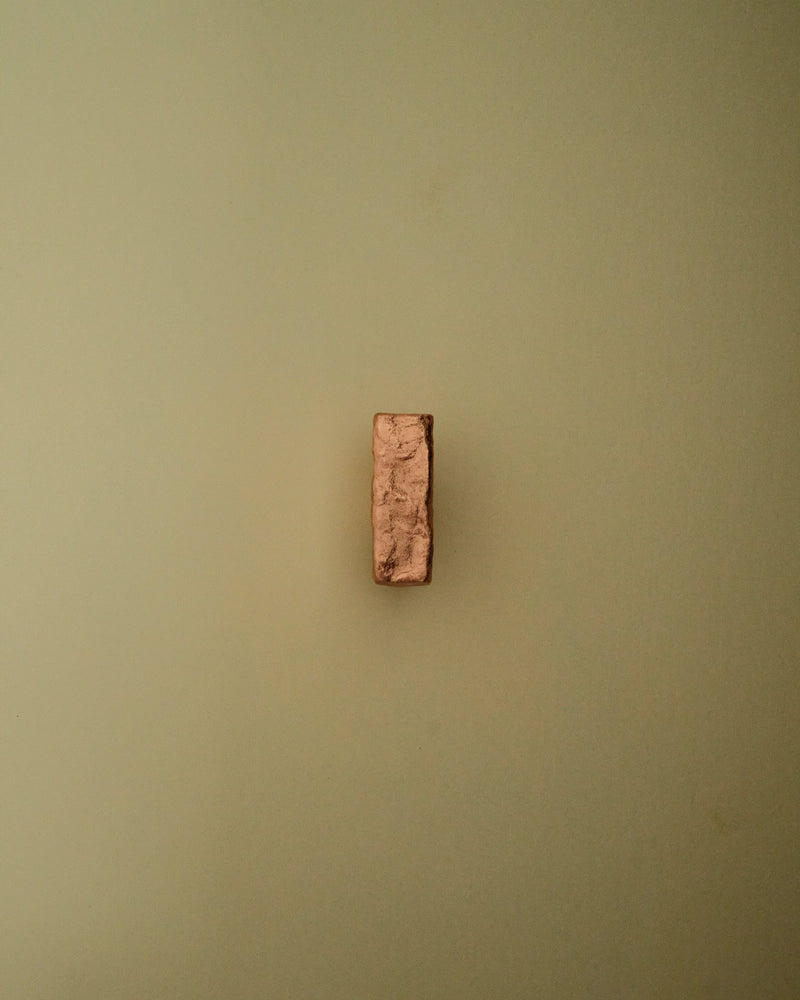
CUBE Knob Medium

Regular price $130.00 CAD
Shipping calculated at checkout.

Imagined through the lens of retrofuturism, our latest series: CUBE. The collection distills retrofuturist ideals into a quietly confident form. Its restrained geometry draws from the forward-looking optimism of the 1960s, a moment when the future was envisioned with clarity, order, and purpose. Subtle yet architectural, and quietly futuristic, the knob bridges mid-century imagination with contemporary interiors — an everyday object that feels both archival and anticipatory.

Also available in 2 more sizes, Large and Small. For finishes, this series is available in Smooth Polished Brass, Chrome, and Natural Bronze.

Lead times are 1-2 weeks to ship if in stock, otherwise 8-10 weeks for custom or made-to-order works. Please contact us for more information.

DIMENSIONS →

1.3" x H x 1.3" W x 1.3" D

MATERIALS →

Cast from brass or bronze and finished by hand in a small, family-run foundry.

DETAILS →

CUBE Knob Spec Sheet (coming soon)

Retrofuturism

This book belongs to a brief but influential moment when the near future felt legible and close enough to predict, yet distant enough to idealize. What distinguishes the book is its tone of measured optimism. Rather than spectacle, Barach emphasized order, efficiency, and rational design: an outlook that aligned closely with mid-century modernism and the emerging language of retrofuturism. The future, as he imagined it, was not chaotic or ornamental, but clean, geometric, and purposeful, shaped by intelligent systems and thoughtful objects.

This vision of progress expressed through clarity and restraint, continues to resonate in contemporary design. It suggests a future built not on excess, but on confidence in form, material honesty, and the quiet authority of well-considered details.

Thumbnail 1
Main Image 1

Image from "1975: And the Changes to Come" - a 1962 book by Arnold B. Barach that presented predictions for the future.

Product Image

Emerging from the postwar period and shaped by the Space Age, atomic research, and rapid industrial growth, retrofuturism blended modern materials with bold simplicity. Designers and thinkers believed good form could guide social progress, and everyday objects were treated as small but meaningful expressions of that belief.

Today, retrofuturism resonates because it reflects a moment of confidence — when the future felt thoughtfully designed. Its appeal lies in that balance of nostalgia and possibility: familiar forms carrying forward-looking intent, grounded in clarity, optimism, and restraint.